Thursday, June 10, 2010

Wednesday, May 19, 2010
Launching "The Local Fresh Food Alliance" - Bald Eagle Valley by Rosalind McIntosh

It is about looking at who we are, our talents, delights, and experience, and matching it with the need at this time and place.
Or as Roshi Bernie Glassman says, "Look in the refrigerator to find how to cook the meal!" (Or perhaps look out the back door if you have come to our "How to Make and Grow Your Own Raised-Bed Vegetable Garden" free demonstration workshop on Saturday May 22, 2010!)
So we take great pleasure in launching for the enjoyment of many --
Opening mid-June the community Green Shop!
Our Local Fresh Food Alliance project is opening in mid-June The Green Shop, a farm stand on Rte 220 Alt near the glider port. It serves as a community outlet for local produce, plants, flowers, crafts, baked goods, products of Teen Entrepreneurs, and as a yard sale. Vendors and customers wanted!
Surplus produce is donated to local food banks, shelters, and soup kitchens.
Voluntary work is available, and for unemployed persons, there is work in exchange for produce or pay.
Next to the Green Shop is our 8' x 4' demonstration raised-bed garden, showing how much produce can be grown in a small closely planted area on top of any surface. The free demonstration workshop building this garden happens this Saturday, May 22, 1 to 3 pm. Please phone Deb 814 353 1270.
Tuesday, May 18, 2010
Being a Worry Buster – Neighbors Helping Neighbors by Rosalind McIntosh

Kelle is now a "Worry Buster"
Who said “Hey! Isn’t this just the best thing we’ve done in a while?”
Members of Appalachian Zen House joined a dozen members of Martha and Julian United Methodist Churches for a morning of work for neighbors who had requested assistance - weeding a steep bank and covering it with a mulch with strong whisky aroma, shifting furniture, using donated carpet to mulch a nursery of young trees intended for the ball park, painting shutters, and cleaning up the community garden.
Tuesday, May 11, 2010
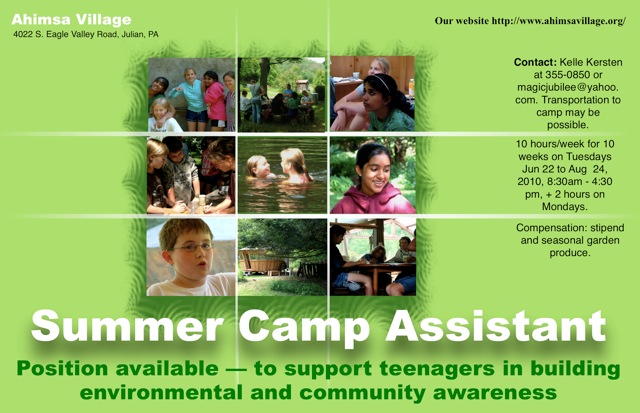
Summer Camp Assistant Wanted

Ahimsa Village is seeking a summer camp assistant for the 2010 Summer Camp. Support teens in building environmental and community awareness. Compensation: Stipend and garden produce. Details at http://www.ahimsavillage.org/images/summer_camp_asst.jpg.jpg
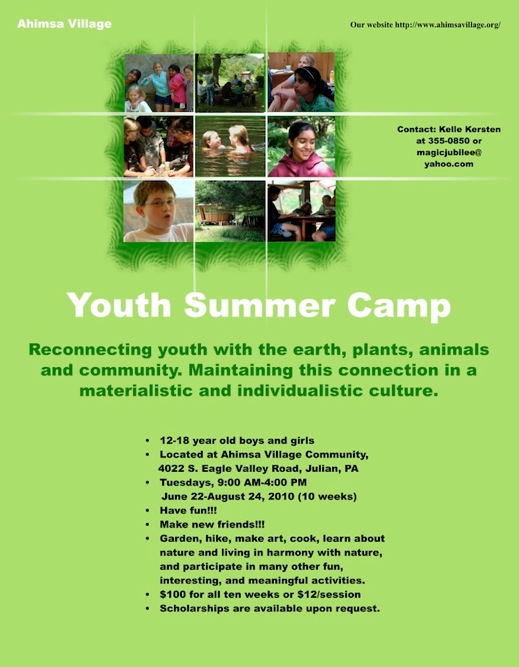
To learn more about the Ahimsa Summer Camp visit the 2009 web page at http://www.ahimsavillage.org/summercamp/
Make and Grow your Own Raised Bed Gardening Workshop - May 22, 2010
Free demonstration workshop to be held at Julian Woods Community, Julian, PA on Saturday from 1-3pm. Contact Deb Fisher at 814-353-1270 to reserve your spot. Details at http://www.appalachianzenhouse.org/images/raised_bed_workshop_color.jpg
Tuesday, April 27, 2010
Intentional Community and Success: Lecture by Bob Flatley on Friday, April 30, 2010 at 7:30PM
Cooperative living makes a lot of practical sense in terms of saving resources, maximizing return on labor, and building synergistic relationships. However, it has been estimated that 9 out of 10 intentional communities in the
Bob Flatley has been researching intentional communities for over 20 years. He is a long-time member of the
Tuesday, March 30, 2010
Upcoming Events in April
Dear Friends: There are a lot of great programs happening in April. Please check out our web site for the latest details.
April 3 Saturday at 7:30PM, Kirtan and the Dances of Universal Peace at O-An Zendo, Julian. For more details go to http://oanzendo.org/
April 21 Wednesday at 7:30, Transition Town State College presents film showing and discussion of "The Power of Community" at the Friends Meeting House, State College. More details to follow. Contact Jackie Bonomo at jabonomo@verizon.net
April 30 Friday at 7:30PM, Lecture by Bob Flatley: Characteristics of Success: An Investigation of the Factors Associated with Success in Intentional Communities. More details will be posted at www.ahimsavillage.org
News Flash: March 28, 2010 - two Transition Town initiatives are getting underway in Centre County - Transition Town State College and Transition Town Bald Eagle Valley. Click here to read article on our blog.
To get involved with TT State College contact Bill Sharp at bsharple@comcast.net
To get involved with TT Bald Eagle contact Deb Fisher at dflowersjulian@gmail.com
Friday, March 26, 2010
TRANSITION CENTRE: From Oil Dependence to Local Resilience by Bill Sharp

Transition Towns is underway in Centre County. A steering group of a dozen is meeting at Ahimsa to found Transition Initiatives in Bald Eagle Valley and in State College. Several other Central Pennsylvania communities are starting to move in this direction.
The goal of the Transition Towns Response is to preemptively adapt to energy scarcity, climate change and growing economic instability. Our goals are to dramatically reduce dependence upon fossil fuels, develop strong local communities, promote our capacity to meet more of our needs locally, achieving a harmony with the environment and leave a legacy of sustainable living for our descendants.
The Transition Response was started in Ireland in 2005 by permaculturalist Rob Hopkins. Rob moved to England where he developed the Transition Towns model published in his guide for forming local initiates, The Transition Handbook. Transition US was founded in December 2008 and Transition Centre in March of 2009. There are now over 265 recognized Transition Town projects (sixty-one of which are in the US) in sixteen countries and many hundreds more forming.
Three of us recently attended a weekend Transition Training and have returned home ready to support the launch of Transition Towns in central Pennsylvania. We are in the process of apply for formal Transition Iniative Status.
You will find our web site at www.transitioncentre.org
Sunday, March 7, 2010
Top "Cleanest" Fruits and Vegetables in the Produce Section
Like the dirty dozen of produce, there is a list of the top cleanest produce you can purchase that is not organic. These are least likely to contain pesticide residue.
Here's the Cleanest:
Bananas
Kiwi
Mangos
Papaya
Pineapples
Watermelons
Asparagus
Avocado
Broccoli
Cauliflower
Corn
Onions
Peas
When organic is not available, here's some tips to protect you from "non-organic" produce:
Here's the Cleanest:
Bananas
Kiwi
Mangos
Papaya
Pineapples
Watermelons
Asparagus
Avocado
Broccoli
Cauliflower
Corn
Onions
Peas
When organic is not available, here's some tips to protect you from "non-organic" produce:
- Buy fresh vegetables and fruits in season.
- Trim tops and the very outer portions of celery, lettuce, cabbages, and other leafy vegetables that may contain the bulk of pesticide residues.
- Peel and cook when appropriate, even though some nutrients and fiber are lost in the process.
- Eat a wide variety of fruits and vegetables. This would limit exposure to any one type of pesticide residue.
- Wait until just before preparation to wash or immerse your produce in clean water. When appropriate, scrub with a brush.
- Special soaps or washes are not needed and could be harmful to you, depending on their ingredients. Read the label!
Sunday, February 7, 2010
AZH Update by Steve Kanji Ruhl

Appalachian Zen House (www.appalachianzenhouse.org) is enjoying a busy and productive season.
As part of our "Green Appalachia" program, we're involved with the Garden Starters project (please see Bill Sharp's report in this AVC newsletter), which is receiving enthusiastic interest from two other Centre County organizations that we're involved with through our "Many Paths, One Heart" multi-faith outreach -- the Interfaith Mission and Interfaith Power and Light.
Through our work with the Interfaith Mission, the Appalachian Zen House is participating in a blanket drive to help low-income people keep warm this winter; we also provide emergency fuel assistance, overnight shelter for homeless people in Centre County, recycled furniture, and other assistance. We're the first Buddhist congregation in the Interfaith Mission's 40-year history, and we've been warmly welcomed by the Christian and Jewish congregations. Kanji serves on the board, and he and Jiko regularly attend meetings. Member congregations of the Interfaith Mission have expressed interest in possibly doing Garden Starter projects at their churches.
Through our work with Interfaith Power and Light, a national organization focused on religious responses to global warming and climate change, Appalachian Zen House has helped to organize the first Pennsylvania chapter, and we are currently developing local environmental projects at Penn State and in the State College area. Kanji and Jiko serve on the steering committee and represent Buddhists in the otherwise Christian and Jewish membership. Again, our participation has been met with warm hospitality. Our Interfaith Power and Light group has expressed interest in endorsing and supporting the Garden Starters initiative.
Also, we soon will begin advertising nationally on the website of the Zen Peacemakers Order for a person to coordinate our Bald Eagle Bio-Fuels program, and also for a farm manager to run the No Harm Farm community-sustained agriculture initiative at Ahimsa Village.
We also have been in contact recently with our supportive friends and neighbors, the Mount Equity Zendo in Pennsdale, PA. The resident monk there, Daishin, is interested in our Bald Eage Bio-Fuels project. Also, the abbess, Dai-En Bennage roshi -- one of the first American women ever ordained as a Zen monastic in Japan, a major figure in international Soto Zen Buddhism, the only authorized Zen teacher in central Pennsylvania, and one of Kanji's teachers -- is featured in the current issue of our Zen Peacemakers Order electronic newsletter, "Socially Engaged Buddhism," speaking of her work in the federal prison at Lewisburg. The Appalachian Zen House is grateful for the friendship of our dharma brothers and sisters at Mt. Equity Zendo.
Jiko is currently working on projects in New Zealand and will return at the beginning of April; she'll assume directorship of Appalachian Zen House in June. Kanji, meanwhile, is training intensively for preceptorship in the Zen Peacemakers Order, assisting his girlfriend Myoki in her studies as head trainee during the Montague Farm Zendo ango period in Massachusetts, and preparing for his new job there as director of the seminary training program and the residence program, which commences in early summer.
Floating Lotus Zendo continues to offer authentic and formally authorized Zen training at Ahimsa Village each Saturday morning; all are welcome.
Garden Starters Program by Bill Sharp

Garden Starters was organized just a few months ago as a vegetable garden project to support new food gardens and gardeners. We are working with Clearwater Conservancy, Spring Creek Watershed Association, Master Gardeners, and a growing list of other groups in and around State College.
To help groups and individuals grow their own fresh food, we plan workshops on making, planting, and maintaining gardens; and cooking and canning food. We will offer mentors, a demonstration garden, and seasonal celebrations. Materials to make gardens, tools, and plants will be provided to those in need. We will present raised-bed gardens for paved areas, the less mobile, and elderly. Involvement of children, youth and families is sought.
The benefits of gardening are many including: self-sufficiency, reduced food bills, fresh vegetables at the peak of their nutritional value, secure food, improved health, a delightful past-time, and having something delicious to share and exchange with neighbors.
We meet twice monthly at Clearwater Conservancy. All are welcome. If you would like information please contact Bill Sharp at bsharple@comcast.net.
Wednesday, February 3, 2010
Reflections on Green Buddhism Talk by Bill Sharp
I had the pleasure of attending a presentation by Steve Kanji Ruhl on Green Buddhism at Ahimsa on December 12, 2009.
For those who may not know Kanji, allow me to draw briefly on his biography. Kanji, born and raised in Central Pennsylvania, has roots in this soil. His academic prowess was evident: He has a MA in Divinity from Harvard. He is a writer and poet. He is a lifelong Zen practioner who has trained in Japan, studied with John Daido Loori Roshi at Zen Mountain Monastery in New York, is a graduate of the Maezumi Institute's Zen House Seminary for Socially Engaged Buddhism and currently a novice minister training with Roshi Bernie Glassman of the Zen Peacemakers. He and Rosalind Jiko Kisan McIntosh opened the first Appalachian Zen House, based at Ahimsa Village last year.
It is impossible to give more than a glancing impression of the experience of his talk and I can do so only from the perspective of how it filtered through my own nervous system. Kanji gave a brief but concise history of Buddhism as it evolved across India, China and to Japan. He related the history of that tradition with that of the West and with our collective ancestor’s reverence for the Earth, trees and animals. I found this intriguing because, although I was brought up in a Christian faith, which is perhaps more focused on life after death than the experience of the real miracle of life between birth and death, I have always had a deep reverence for the Earth; perhaps as a result of growing up in a rural environment and due to my Celtic and Native American blood. But he also brought home the lessons I learned from the Japanese while once stationed in a remote area of Kyushu where I had my first direct encounter with both Buddhism and Shinto and my first real spiritual awakening.
Over my lifetime there has been a gradual, albeit limited, return to a more earthy religion. As Kanji pointed out, in the dim history of all our faiths, at the root of all of our civilizations, there were religious and spiritual traditions that reverences earth, air, fire and water and the flora and fauna that gave life to the world of matter and energy. As a longtime resident of the Southwest, and familiar with its Native cultures, I am reminded that the food we grow has been reverenced by our forbearers. Such traditions live, if barely, in forms such as Holy Communion where bread and wine are used as symbols of our deepest reverence. More and more people are returning to a sense of the sacred in growing, sharing and eating good foods.
Kanji talked about the spiritual people who retreated to the countryside in China and Japan, and also St. Francis. I’ve toured both Zen and Christian monasteries and marveled at the beauty and simplicity of life withdrawn from the bustle of city life. I find the best of the monastic traditions, both East and West in the times they were self-sufficient. Such highly disciplined and focused lives give the residents of these places an opportunity to sharpen their spiritual perceptions and may, I would hope, allow them to more completely focus on the here and now such as celebrated by the Buddhist.
Kanji talked about the Bodhisattva path, the deep compassion felt by great souls for all living things and the commitment by them to foregoing final enlightenment until all have been brought to fulfillment. He brought the spiritual dimensions of the environment movement up to date with examples of Green Buddhist leadership such as that of the Dali Lama and Thich Nhat Hahn but he also gave due credit to Pope Benedict, who just a couple of weeks ago denounced the world leader’s failure at the Copenhagen Climate Conference, and mainstream Protestantism and Christian evangelicals such as Rick Warren and Jim Wallis. I have worked with faith-based groups for a number of years and I am delighted to see a resurgence of interest in spiritual stewardship which needs to be encouraged.
There are important lessons for us in Kanji’s talk and his mission. I believe we are experiencing one of those times in human history like those that gave rise to its great spiritual traditions. We need, I am convinced, to more deeply reflect on our reality and flame that spark of compassion that assures us not only of personal salvation but the well-being of all that lives on this Earth.
Bill Sharp lives in State College. He is retired from a career in education, public service and business. He is active in developing more sustainable communities, is affiliated with the Transition Towns movement and chairs the Garden Starters group that meets twice monthly at ClearWater Conservancy. Bill can be reached at bsharple@comcast.net
Friday, January 29, 2010
It's Time to Step Up & Defend Animals in PA
There are two important bills being considered by our State Legislature in Harrisburg. Let's let our elected officials (and candidates) know where we stand.
House Bill 1411 and Senate Bill 843 would ban live pigeon shoots and the use of launched or tethered live animals as shooting targets.
Senate Bill 50 would amend and strengthen the Dog Purchaser Protection Act, which holds sellers accountable for the health of the dogs they sell.
Please let your State Representative and State Senator know that you support these Bills and expect them to do the same. And anyone new running for the Legislature in 2010 also needs to be asked where they stand on these issues.
We need to be united in favor of protecting innocent birds and animals in Pennsylvania.
(information from Bob and Lynn Millar)
Thursday, December 31, 2009
Vegetarianism: The most important solution to Global Warming
A friend sent this to me. Thought it might be of interest to some of you.
Dear Friend,
In the run up to the Copenhagen climate change conference, it is vital the following information be disseminated to the public as well as to our political leaders.
A widely cited 2006 report by the United Nations Food and Agriculture Organization, Livestock's Long Shadow, estimates that 18 percent of annual worldwide greenhouse gas (GHG) emissions are attributable to livestock….however recent analysis by Goodland and Anhang co-authors of "Livestock and Climate Change" in the latest issue of World Watch magazine found that livestock and their byproducts actually account for at least 32.6 billion tons of carbon dioxide per year, or 51 percent of annual worldwide GHG emissions!
The main sources of GHGs from animal agriculture are: (1) Deforestation of the rainforests to grow feed for livestock. (2) Methane from manure waste. – Methane is 72 times more potent as a global warming gas than CO2 (3) Refrigeration and transport of meat around the world. (4) Raising, processing and slaughtering of the animal.
Meat production also uses a massive amount of water and other resources which would be better used to feed the world’s hungry and provide water to those in need.
Based on their research, Goodland and Anhang conclude that replacing livestock products with soy-based and other alternatives would be the best strategy for reversing climate change. They say "This approach would have far more rapid effects on GHG emissions and their atmospheric concentrations-and thus on the rate the climate is warming-than actions to replace fossil fuels with renewable energy."
The fact is that we are being informed of the dangerous path we are on by depending greatly on animal flesh for human consumption. We still have the opportunity to make the most effective steps in saving ourselves and this planet. By simply choosing a plant based diet we can reduce our carbon foot print by a huge amount.
We are gambling with our lives and with those of our future generations to come. It's madness to know we are fully aware of the possible consequences but yet are failing to act.
Please make a truly environmental, healthy and compassionate choice, choose to drastically reduce your meat intake or simply go vegetarian or vegan. This is the single most powerful action for preventing climate change as it is the single largest source of greenhouse gas emissions.
Thank you for your consideration.
Yours Sincerely
Amber Sykes
Tuesday, December 22, 2009
Top Ten Green Buddhists by Steve Kanji Ruhl
Among the many activities of the worldwide movement in Socially Engaged Buddhism today, perhaps the most significant are those related to Buddhist environmentalism, or Green Buddhism. Ranging from efforts of the Dalai Lama to have the entire Tibetan plateau declared a "natural park" and wildlife refuge called the Zone of Ahimsa, to strategies by monks in Thailand to prevent over-logging, to Thich Nhat Hanh's ecological awareness campaigns within his Order of Interbeing, to the decades-long commitment of American Buddhists such as Gary Snyder and John Daido Loori and Joanna Macy to honor and protect wilderness and sustainable human cultures and all living beings, the Green Buddhist movement is dynamic, vitally important, and inspiring to Buddhists and non-Buddhists alike. (And it also includes the activities of the "Green Appalachia" program sponsored by the Zen Peacemakers Order in partnership with Ahimsa Village in central Pennsylvania.) Unlike the Christian environmental movement, Green Buddhism does not espouse the ideal of responsible human stewardship of God's Creation, a view that affords humans a priveleged position within nature. Rather, Green Buddhism invokes the fundamental Buddhist principle of interconnectedness, in order to express the truth of the profound interdependence of everything within the cosmos, humans linked to animals and plants and oceans and mountains and stars in a harmonious network of interbeing.
Here's my top 10 list of Green Buddhists, in alphabetical order:
1. The Dalai Lama
2. Wendy Johnson
3. Stephanie Kaza
4. John Daido Loori
5. Joanna Macy
6. Peter Muryo Matthiessen
7. Thich Nhat Hanh
8. Prayudh Payutto
9. Sulak Sivaraksa
10. Gary Snyder
Honorable Mentions:
Robert Aitken, Rita Gross, the Karmapa (Ogyen Trinley Dorje)
Sunday, December 20, 2009
Film Recommendation - The Shift by Wayne Dyer

I just finished watching a great new film titled The Shift (2009) by Wayne Dyer. This is Dyer's first film. He is best known for his many bestselling books on self-help and the spiritual life. The film follows the lives of a group of people who are on vacation at a beautiful California oceanside retreat center. One group is a film crew who has come to interview Dyer about his latest book on the spiritual life. The segments of this interview are masterfully interwoven with the lives of the people at the retreat center illustrating in dramatic fashion what Dyer is talking about. Its a very powerful and effective method. I really learned a lot from this film - its all about making the shift from an ego-centered life to a service-centered life, letting go of our personal agendas and allowing our true self or as Dyer calls it our Authentic Self to manifest. Its there all the time, we just have to let go of our ego so it can shine forth. A truly remarkable and inspiring film. Highly recommended. To learn more about the film, visit the film's web site at http://www.dyermovie.com/. We plan to have a showing and discussion of the film at Ahimsa Village this year. -- Bob Flatley
January Program - Building Strong Local Economies and Community with Bill Sharp
Please consider attending our January Sustainabilty Talk on Friday, January 8, 2010 at 7:30PM at Ahimsa Village farmhouse, Julian, PA 16844. Details below:
This workshop focuses on the inevitability of local communities turning towards increasingly self-sufficient economies as a response to changes in the global climate, economy and steady rise in the cost of energy. The workshop will discuss the conditions leading to the current social and economic crises, outline a model for a self-sufficient community; and open a dialogue on how such a community can be pursued.
Bill Sharp has been active in environmental and economic development issues for over 40 years. He has been a teacher, planner and manager in higher education, government and business. His has worked in urban and rural areas, served on and been an officer of several non-profit organizations and associations and been forming member of several of these. He has a life-long interest in community. He is currently working to develop an architecture for self-sufficient communities and is a local supporter of the Transition US and UK based Transition Towns network.
Light refreshments at 7:30pm, followed by program. Please RSVP to bob@ahimsavillage.org, 814-355-0850 if you plan to join us. Suggested donation $5 benefits the Ahimsa Education Committee.
Wednesday, December 2, 2009
Green Buddhism Talk at Ahimsa Village with Steve Kanji Ruhl
Green Buddhism:
Using the Ancient Buddha Way to Meet Our 21st Century Environmental Crisis
Friday, December 11, 2009 at 7:30PM
What do Zen master Thich Nhat Hanh, Pulitzer Prize winning writers Gary Snyder and Peter Matthiessen, the Dalai Lama, and activist Joanna Macy have in common? They're all part of the widespread Green Buddhism movement.
Please join us for this lively, fascinating, and unique presentation. It will offer a global perspective of Buddhist relations to nature, discuss Buddhist philosophical approaches to the environment, compare these to other world religions, explain the rise of the modern Green Buddhist movement in Asia and America, and describe how Zen Buddhists are now addressing environmental concerns in central PA and offering models for sustainable living and healing the earth.
Steve Kanji Ruhl received his Master of Divinity degree from Harvard University. Kanji is a lay Buddhist minister in the Zen Peacemakers Order, completing his training for ordination as a Soto Zen Buddhist priest. He is also a longtime environmentalist, an active lover of the sacred outdoors and member of such eco-organizations as the Sierra Club, the Creation Care Coalition of Centre County, and Interfaith Power and Light.
Light refreshments at 7:30pm, followed by program. Please RSVP to e4bob@yahoo.com, 814-355-0850 if you plan to join us. Suggested donation $5 benefits the Ahimsa Education Committee.
Wednesday, November 11, 2009
The Henry George Perspective by Mike Curtis
Mike Curtis conducted a one-day workshop at Ahimsa Village on Oct. 18, 2009 on the economic philosophy of Henry George. Below is a summary of that workshop. Mike can be reached at mikecurtisarden@verizon.net. You can learn more about George by taking Mike's mini-course at http://www.ahimsavillage.org/henrygeorge.htm
There are many robbers in our midst: governments that steal with unjust taxes, inflation that robs those who have saved, and bankers that consume without having to produce. There are a myriad of other monopolists that rob the hard earned wealth from those who have worked and produced it. But, no matter how little or how much each of these other robbers take, there is one robber that takes all that is left, save just enough to create the incentives needed for production. And for those with the least education and skill all is taken, but a bare subsistence. The robber that takes all that is left is private property in land.
All the natural opportunities on which, and from which, we live — even the electromagnetic spectrum — is part of the land. And because there is no longer any free land place where people can live and employ themselves, wages tend toward those of chattel slavery.
Some workers are able to buy land and enjoy an advantage, even become robbers themselves — just as chattel slaves could sometimes buy their freedom and even buy other slaves; but private property in land, as slavery in the past, is none-the-less the ultimate robber of those who work and produce.
The income from land takes all the benefits of the general increase in the level of education, the infrastructure, invention, and the progress of technologies while wages tend to remain constant. That is why the increase in productivity never increases labor's standard of living nor eliminates the need for a Minimum Wage.
As the income of land continues to rise, the selling price of land is bid higher and higher by expectations of even greater incomes in the future.
The more the owners of unused land are offered, the greater the expectation of future offers and the less likely they are to sell. As machines replace workers more land is needed. Whether it is a farm worker who is replaced by a tractor that can plow more land or a factory worker who is replaced by automation each of those workers must have some other place to work. However, when those who are holding idle land as an investment refuse to sell, those who has been replaced by machinery cannot be reemployed.
The unemployed workers don’t buy as many of the products of other people’s labor, so factories lay off some of their workers. The more workers that are laid off the less demand for goods and services so more workers are laid off. Only after enough land becomes affordable that producers (workers) can access it does a recession or depression be end.
The Henry George Proposal
Eliminate all taxes that are levied on things produced or incomes from production and, instead, fund all public expenditures from the rental value of land. We must have exclusive use of land, for who would plant a crop or build a house — much less a modern factory — if they couldn't put up a fence and lock the door? By making the title to land conditional upon a payment of its rental value, the equal rights of every other member of the community to that same parcel of land would be satisfied.
As the holders land were only renting, the incentive would be to use the least possible amount of land and produce as much as possible on it; that is, within the limits of health, safety, and environmental sustainability, for the Earth belongs equally to all future generations as well.
As people would no longer hold land as an appreciating asset, there would be a much more intense development of the urban and suburban areas. As people migrated toward the centers of population, the demand and value of rural areas would fall. Large areas of the wilderness would remain natural and uninhabited. Somewhere between the edge of suburbia and the wilderness would emerge a free land alternative --- a place where land could be used, lived, and worked on without the payment of rent. Perhaps only a minute fraction of the population would actually live and work on the free land, but no one would work for some one else unless they were offered a higher standard of living than they could produce working for themselves.
Because no one could afford to hold unused land there would always be a free land alternative insuring high wages that would increase with the advance of material progress. The return to buildings, machinery, and products in the making would also increase as wages increase.
Because most new technologies increase productivity more where population is dense, the rental value of land from these areas would provide an increasing fund for the increasing needs of social growth. Not only would we see full employment, wages and the return to savings increase, but society would have increasing resources to pay for national healthcare and the development of appropriate energy. It is even likely that there would soon be resources to dispense a cash dividend equally to all our residents, who, by their cooperative presence, have created the value which attaches to land.
Businesses in which there can not reasonably be competition — like the roads and utilities — must be operated by the government. All other monopolies should be abolished.
The best mechanism to decide who produces what will then be the rewards of free people exchanging their labor for the products of other people's labor in the free market — a market that decides not only the value of everything else, but the rental value of land, which belongs to the community and society as a whole.
Subscribe to:
Posts (Atom)